Lord Krishna: His Birth, Life, Mahabharata, Teachings, and Legacy
Lord Krishna is one of the most widely revered figures in Hinduism. He is worshipped as an avatar of Vishnu in many Hindu traditions and as the Supreme Being in several Vaishnava traditions. His story spans devotion, philosophy, politics, warfare, friendship, leadership, and questions about right action.
According to Hindu sacred traditions, Krishna was born in Mathura, raised in Gokul and Vrindavan, later became a major political and diplomatic figure, and played a decisive role in the Mahabharata. On the battlefield of Kurukshetra, he became Arjuna's charioteer and spiritual guide and delivered the teachings of the Bhagavad Gita.
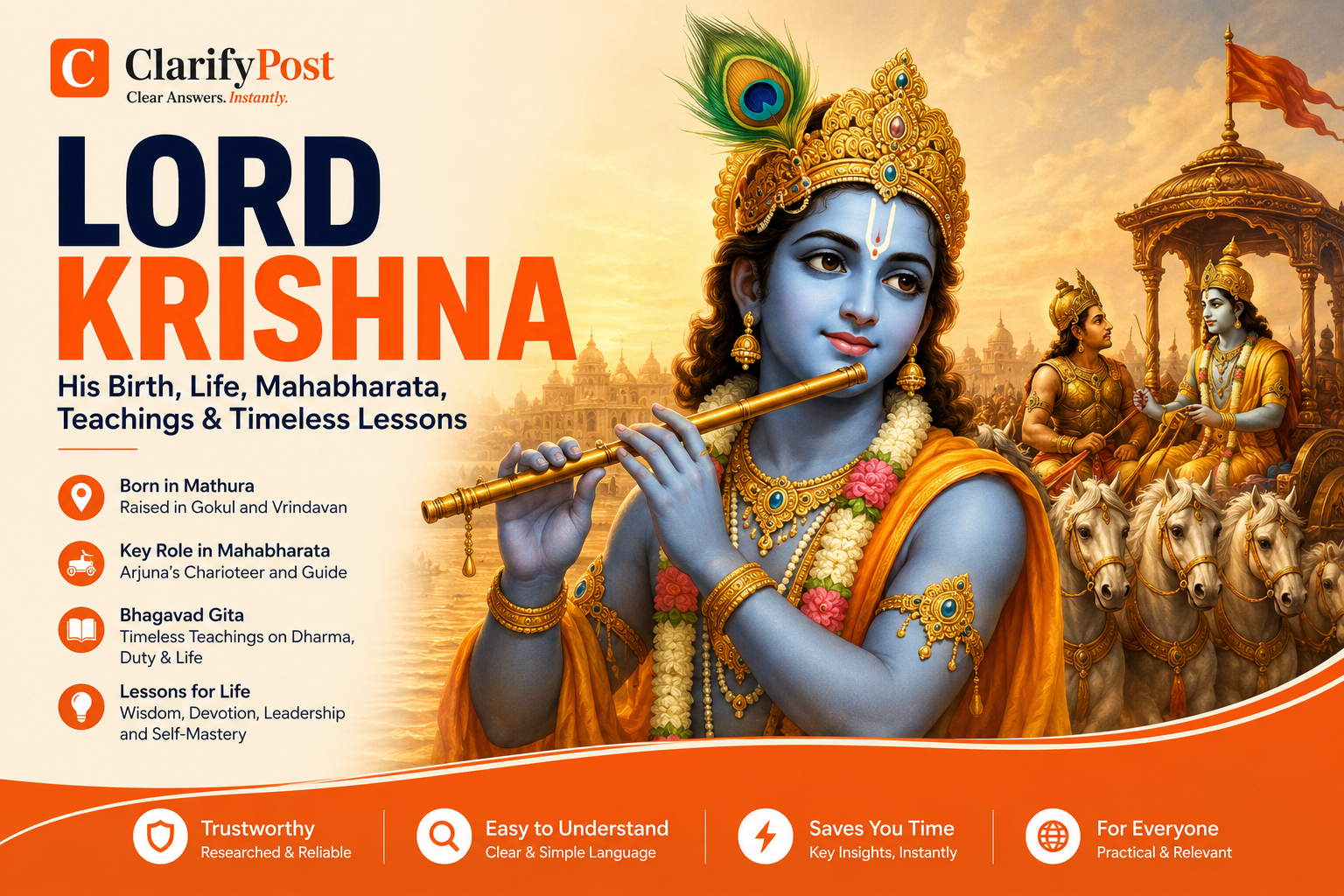
The story of Krishna is found across several Hindu texts, especially the Mahabharata, Harivamsa, Bhagavata Purana, and Vishnu Purana. These sources developed across different periods, and versions of Krishna's life sometimes differ in detail.
That is why it is useful to separate two things:
What Hindu traditions believe about Krishna and what historians can establish about his historical chronology.
Krishna's religious importance is unquestioned within Hindu traditions, while the exact dates of his life remain a matter of debate rather than an established historical fact.
Where Was Lord Krishna Born?
According to Hindu tradition, Krishna was born in Mathura, in present-day Uttar Pradesh, India.
He was the son of Devaki and Vasudeva. Devaki's brother, Kamsa, was the ruler of Mathura and is portrayed in the traditional narratives as a tyrant who feared a prophecy that Devaki's child would eventually cause his downfall.
Because of this prophecy, Kamsa imprisoned Devaki and Vasudeva.
According to the traditional account, Krishna was born as their eighth child. His father then carried the infant out of Mathura and across the Yamuna to protect him from Kamsa. Krishna was raised by Nanda and Yashoda in the pastoral community of Gokul and later associated closely with Vrindavan.
Krishna's birthplace remains one of Hinduism's major pilgrimage locations, and Krishna Janmashtami is celebrated annually in remembrance of his birth.
Mathura is traditionally regarded as Krishna's birthplace. Today, Mathura and nearby Vrindavan are among the most important pilgrimage centers associated with Krishna.
Krishna's Life Timeline
There is no universally accepted historical calendar for Krishna's life. Hindu traditions place his life within the larger framework of the Yuga cycle, while historians note that the literary sources do not provide a chronology that can be securely converted into modern historical dates.
A useful timeline based on the traditional narratives is:
| Stage | Traditional account |
|---|---|
| Birth | Born in Mathura to Devaki and Vasudeva |
| Childhood | Raised by Nanda and Yashoda in Gokul |
| Youth | Associated with Vrindavan, cowherding communities, music, devotion, and stories of divine play |
| Return to Mathura | Confronted and defeated Kamsa |
| Dvaraka | Associated with the Yadava migration and the city of Dvaraka |
| Political life | Became a leader, adviser, diplomat, and ally of the Pandavas |
| Kurukshetra | Became Arjuna's charioteer during the Mahabharata war |
| Bhagavad Gita | Gave Arjuna a philosophical teaching on duty, action, knowledge, and devotion |
| Final years | Traditional narratives describe the destruction of the Yadava clan and Krishna's death and ascension |
These events are drawn from multiple literary traditions, and details vary among texts.
Krishna's Childhood in Gokul and Vrindavan
The childhood of Krishna is perhaps the most beloved part of his story.
Unlike the political Krishna of the Mahabharata, the young Krishna is often portrayed as playful, affectionate, mischievous, and deeply connected to ordinary village life.
He is described as a cowherd who spent his childhood among the people of Vraja.
Many popular stories come from later Puranic traditions, particularly the Bhagavata Purana. They include Krishna stealing butter, playing his flute, protecting the people of Vrindavan, and performing extraordinary deeds.
He is famously associated with:
- Makhan Chor — the playful butter thief
- Govardhan Hill — which he is traditionally said to have lifted to protect the community
- Kaliya — the serpent associated with the Yamuna
- Radha and the Gopis — central figures in devotional traditions of Krishna
These stories are not merely childhood adventures within Hindu theology. They became powerful expressions of bhakti, or loving devotion toward the divine.
Why Did Krishna Leave Vrindavan?
The traditional stories describe Krishna eventually leaving the pastoral world of Vrindavan and returning to Mathura.
The reason was connected to Kamsa, who remained a threat to Krishna's family and community.
Krishna eventually confronted Kamsa and killed him, bringing an end to his uncle's rule and restoring authority to Kamsa's father, Ugrasena, according to the traditional narratives.
Krishna's departure from Vrindavan became especially important in later devotional traditions because it represents both love and separation.
For devotees, the longing for Krishna after his departure becomes a metaphor for the soul's longing for the divine.
Krishna in Dvaraka
After his conflict with Kamsa and subsequent political struggles, Krishna became closely associated with Dvaraka, traditionally described as a fortified city connected with the Yadava people.
The Mahabharata and related traditions present Krishna as a powerful political leader rather than simply a religious figure.
He was involved in alliances, diplomacy, family politics, and the larger struggle between the Pandavas and Kauravas.
His importance in the Mahabharata comes partly from his relationship with the Pandavas. Krishna was related to them through his family connection to Kunti, the mother of the Pandavas.
How Was Krishna Connected to the Mahabharata?
Krishna did not begin the Mahabharata war simply because he wanted a battle.
Instead, the epic presents him as someone who attempted to navigate a deeply complicated political and moral conflict.
The central conflict was between the Pandavas and Kauravas, two branches of the Kuru royal family.
The dispute involved:
- succession
- political power
- humiliation and injustice
- broken agreements
- exile
- the refusal to return the Pandavas' rights
- the failure of diplomatic efforts
Krishna became increasingly involved as a trusted ally of the Pandavas.
Krishna's Peace Mission
Before the war began, Krishna attempted to negotiate peace between the two sides.
He went to the Kaurava court as an emissary on behalf of the Pandavas.
According to the epic narrative, the Pandavas were willing to accept a much smaller settlement rather than demand the entire kingdom.
The negotiations failed.
Duryodhana refused to accept the proposed settlement, and the conflict moved toward war.
This part of Krishna's story is important because it shows him not merely as a battlefield strategist but also as a diplomat who attempted negotiation before war.
In the traditional Mahabharata narrative, Krishna first participates in efforts to find a peaceful settlement. The failure of diplomacy becomes one of the major steps leading to the Kurukshetra war.
Did Krishna Fight in the Mahabharata War?
This is one of the most commonly misunderstood parts of Krishna's story.
Krishna was not a conventional combatant in the Kurukshetra war.
When both sides sought his support, Krishna offered a choice: one side could have his powerful army, while the other could have Krishna himself, but he would remain unarmed and would not fight.
Duryodhana chose Krishna's army.
Arjuna chose Krishna himself.
Krishna therefore became Arjuna's charioteer. This decision captures something central about Krishna's role.
His greatest weapon in the war was not necessarily a physical weapon.
It was guidance.
Krishna as Arjuna's Charioteer
On the battlefield of Kurukshetra, Arjuna saw teachers, relatives, friends, and members of his own family standing on the opposite side.
He became overwhelmed by the moral consequences of fighting them.
Arjuna questioned whether victory was worth such destruction.
Krishna responded with a philosophical discourse that became the Bhagavad Gita.
The Gita is traditionally presented as a dialogue between Krishna and Arjuna and contains 18 chapters and 700 verses in the standard recension.
What Is the Bhagavad Gita?
The Bhagavad Gita is one of the most influential texts in Hindu philosophy.
It addresses questions such as:
What is my duty?
How should I act when every choice has consequences?
What is the self?
What does it mean to live without attachment?
How can action and spirituality coexist?
Krishna teaches Arjuna concepts associated with:
- Dharma — righteous duty and right conduct
- Karma Yoga — disciplined action without attachment to results
- Jnana Yoga — the path of knowledge
- Bhakti Yoga — devotion and loving surrender
- Atman — the deeper self
- Detachment — acting without being controlled by personal attachment
The Gita is therefore more than a war speech. It is a philosophical discussion about how a person should act when facing moral uncertainty.
Krishna and the Concept of Dharma
One of Krishna's most important teachings is the idea of dharma.
Dharma can be difficult to translate with a single English word. Depending on context, it can refer to duty, righteousness, moral order, proper conduct, or one's responsibilities.
Krishna's guidance to Arjuna is not simply:
"Fight because I told you to."
Instead, the Gita explores the responsibilities of an individual who must act within a morally difficult situation.
That is one reason the text has remained influential for centuries.
Why Do Hindus Consider Krishna a Lord?
Hindu traditions do not all describe Krishna in exactly the same theological way.
In many traditions, Krishna is regarded as the eighth avatar of Vishnu.
In several Vaishnava traditions, particularly those centered on Krishna, he is understood as the Supreme Being rather than merely an avatar.
The Bhagavad Gita itself presents Krishna as a divine figure who reveals his cosmic nature to Arjuna.
His identity is therefore theological, devotional, and philosophical—not simply that of a historical king or warrior.
Oxford scholarship describes Krishna as a figure who can be understood in multiple overlapping ways: a heroic prince, a playful child, a lover, and the supreme God incarnate in human form within devotional traditions.
Krishna as Vishnu's Avatar
The idea of an avatar is central to Vaishnavism.
An avatar is a divine manifestation or descent.
In many Hindu traditions, Vishnu is understood as preserving cosmic order, and Krishna is considered one of Vishnu's major manifestations.
However, some Krishna-centered traditions reverse the relationship and understand Vishnu as proceeding from Krishna.
These differences are part of Hinduism's rich theological diversity.
It is therefore more accurate to say:
Many Hindus worship Krishna as Vishnu's avatar, while some traditions worship Krishna as the Supreme God himself.
Krishna's Relationship With Radha
Radha is one of the most important figures in later Krishna devotional traditions.
She represents the ideal of intense and selfless love for Krishna.
The relationship between Radha and Krishna is especially important in Bhakti traditions, where their love is interpreted spiritually rather than simply as an ordinary romantic relationship.
However, Radha's prominence developed differently across Hindu literature and traditions, and she is not presented in exactly the same way in every early source.
Krishna's Role as a Leader
Krishna's story is unusual because he appears in many different roles.
He is portrayed as:
Child — playful and curious.
Friend — deeply loyal to his companions.
Protector — defending his community.
Political leader — involved in the affairs of kings and kingdoms.
Diplomat — attempting peace before war.
Strategist — helping the Pandavas navigate the Kurukshetra conflict.
Charioteer — serving Arjuna rather than demanding a throne.
Teacher — explaining the Bhagavad Gita.
Divine figure — worshipped across major Hindu traditions.
This combination helps explain why Krishna occupies such a unique place in Indian religious and cultural history.
Krishna's Strategies in the Mahabharata
Krishna's actions during the war raise difficult ethical questions.
He helped the Pandavas defeat powerful opponents, but some of the strategies used in the epic involve deception or departures from conventional warrior codes.
Examples include the strategies surrounding:
- Bhishma
- Drona
- Karna
- Jayadratha
This creates an important tension within Krishna's story.
Can a questionable action become justified when the alternative is the continuation of injustice?
The Mahabharata does not always provide simple answers.
Instead, it repeatedly explores the conflict between ideal morality and practical responsibility.
This is one reason Krishna remains such a powerful philosophical figure.
His story is not simply about good people versus bad people.
It is about what people should do when every available choice has a cost.
Krishna's Teachings: Lessons for Modern Life
Krishna's teachings in the Bhagavad Gita have been interpreted in many ways.
Here are some of the most commonly associated lessons.
1. Focus on Your Work, Not Only the Result
One of the central ideas associated with Karma Yoga is acting properly without becoming consumed by the outcome.
In modern terms:
Do your best work without allowing fear of failure or obsession with success to control you.
You can control your effort more directly than you can control every external result.
2. Do Not Run From Difficult Responsibilities
Arjuna wanted to withdraw because the situation was emotionally overwhelming.
Krishna challenged him to confront his responsibilities rather than simply escape them.
The lesson is not that every conflict must be fought.
It is that avoiding a difficult responsibility does not automatically solve the underlying problem.
3. Control the Mind
The Gita repeatedly emphasizes self-discipline.
Anger, desire, fear, ego, and attachment can distort judgment.
Krishna's teaching therefore places importance on developing a disciplined mind.
4. Choose Action Over Paralysis
Arjuna's crisis was partly a crisis of indecision.
Krishna guides him toward thoughtful action.
For modern life, the lesson can be understood as:
Reflection is valuable, but endless hesitation can become its own form of failure.
5. Stay Balanced
Krishna's teachings emphasize steadiness in success and failure.
That does not mean becoming emotionless.
It means not allowing temporary victories or defeats to completely determine your sense of identity.
6. Seek Knowledge
The Gita combines action with knowledge.
Krishna encourages Arjuna to understand himself, his responsibilities, and the nature of reality.
This suggests that good decisions require more than motivation.
They require understanding.
7. Practice Devotion
Bhakti is one of the major paths discussed in the Gita.
Devotion means developing a relationship with the divine through trust, love, remembrance, and surrender.
For millions of Hindus, this remains one of the most important dimensions of Krishna worship.
8. Do Not Let Ego Control You
Krishna repeatedly challenges attachment to the idea:
"I am the sole doer."
The teaching emphasizes that individuals are part of larger systems and responsibilities.
In everyday life, that can be understood as a reminder to remain humble.
The Four Paths Commonly Associated With Krishna's Teaching
The Gita brings together several approaches rather than offering only one spiritual method.
| Path | Core idea |
|---|---|
| Karma Yoga | Selfless and disciplined action |
| Jnana Yoga | Knowledge and understanding |
| Bhakti Yoga | Devotion and love toward the divine |
| Dhyana / Meditation | Mental discipline and concentration |
These paths have been interpreted differently by different Hindu philosophical schools, but together they demonstrate the broad range of the Gita's teachings.
Why Is Krishna Still Important Today?
Krishna is not remembered only because of an ancient epic.
He remains central to Hindu religious life.
His influence appears in:
- temples
- festivals
- devotional music
- classical and folk dance
- painting
- sculpture
- literature
- philosophy
- television and cinema
- modern spiritual movements
Janmashtami, the festival celebrating Krishna's birth, is observed widely in India and among Hindu communities around the world. :[oaicite:18]{index=18}
Krishna is also one of the most internationally recognized Hindu religious figures.
Krishna Janmashtami
Krishna Janmashtami celebrates Krishna's birth.
The festival is observed according to the Hindu lunisolar calendar and generally falls in August or September.
Many celebrations include:
- fasting
- devotional singing
- temple ceremonies
- readings from sacred texts
- midnight worship
- dramatic performances
- decorations
- processions
- celebrations associated with Dahi Handi in some regions
Mathura and Vrindavan are particularly important locations for Krishna Janmashtami celebrations. :
Did Krishna Actually Live?
This is a different question from whether Krishna is considered divine.
Hindu believers generally accept Krishna as a real divine figure within their religious tradition.
Historians, however, approach the question differently.
Oxford's scholarship notes that Krishna's historical origins are obscure and debated. Evidence for Krishna worship exists from the centuries before the Common Era, including inscriptions and other archaeological evidence, but this does not establish every event in the traditional biographies as historical fact.
There is also no scholarly consensus establishing a precise modern calendar date for Krishna's birth.
Therefore, claims such as an exact birth year should be presented as traditional calculations or religious chronology, not as universally established historical dates.
Krishna's divine status is a matter of religious belief and theology. His historical origins and exact chronology are subjects of scholarly debate. Keeping these categories separate helps explain Krishna accurately and respectfully.
What Happened to Krishna?
The final part of Krishna's traditional life is described in several Hindu texts.
After the Kurukshetra period, the Yadava community eventually faced internal destruction.
Later narratives describe Krishna living in the region of Dvaraka before being fatally wounded by a hunter named Jara.
Krishna's death is not presented as an ordinary end in Hindu theology.
Traditions describe his departure or ascent as part of the divine cycle associated with his incarnation.
The narratives surrounding this event are found in the later sections of the Mahabharata and Puranic literature, and details differ across sources.
Krishna's Greatest Legacy
Krishna's influence goes far beyond the story of the Mahabharata.
His legacy operates on several levels at once.
Religious Legacy
He is one of Hinduism's most widely worshipped deities.
Philosophical Legacy
The Bhagavad Gita remains one of the most influential works of Indian philosophy and religion.
Cultural Legacy
Stories of Krishna shaped music, dance, painting, literature, theatre, festivals, and temple traditions.
Ethical Legacy
His conversations with Arjuna continue to raise questions about duty, morality, responsibility, power, and action.
Devotional Legacy
Bhakti traditions transformed Krishna into an intimate figure of love, friendship, compassion, and spiritual devotion.
Krishna in One Sentence
If Krishna's story had to be summarized in one sentence, it would be this:
Krishna is remembered not only as a divine figure, but as a guide who teaches people how to act with wisdom, fulfill responsibility, control attachment, and seek a deeper understanding of life.
His story moves from the prison of Mathura to the villages of Vrindavan, from royal politics in Dvaraka to the battlefield of Kurukshetra, and finally to the philosophical teachings of the Bhagavad Gita.
That extraordinary range is one reason Krishna has remained one of the most influential figures in Indian religious and cultural history.
Frequently Asked Questions
Q: Where was Lord Krishna born?
A: According to Hindu tradition, Krishna was born in Mathura, in present-day Uttar Pradesh, India, to Devaki and Vasudeva.
Q: Who were Krishna's parents?
A: His traditional parents were Devaki and Vasudeva. He was raised by his foster parents, Nanda and Yashoda.
Q: Where did Krishna grow up?
A: Krishna's childhood is traditionally associated with Gokul and Vrindavan, where he was raised among cowherding communities.
Q: Was Krishna an avatar of Vishnu?
A: In many Hindu traditions, Krishna is worshipped as the eighth avatar of Vishnu. Some Krishna-centered Vaishnava traditions instead understand Krishna as the Supreme Being from whom other divine manifestations proceed.
Q: Did Krishna fight in the Mahabharata war?
A: Krishna served as Arjuna's charioteer and guide and traditionally took a non-combatant role. His strategic guidance was nevertheless crucial to the Pandavas' campaign.
Q: Did Krishna start the Mahabharata war?
A: No. The Mahabharata presents a long political conflict between the Pandavas and Kauravas. Krishna attempted diplomatic negotiation before the war, but those efforts failed.
Q: What is Krishna's most important teaching?
A: One of the central ideas associated with Krishna's teaching is to perform one's duty without becoming attached to the outcome. The Bhagavad Gita combines this with teachings on knowledge, devotion, self-discipline, and spiritual understanding.
Q: What is the Bhagavad Gita?
A: The Bhagavad Gita is a major Hindu scripture presented as a dialogue between Krishna and Arjuna on the battlefield of Kurukshetra. It forms part of the Mahabharata and is traditionally organized into 18 chapters and 700 verses.
Q: Why do Hindus worship Krishna?
A: Hindus worship Krishna because he is understood as a divine manifestation of Vishnu or, in some traditions, as the Supreme God himself. His teachings, stories, compassion, divine play, and role in the Bhagavad Gita are central to Krishna devotion.
Q: What can we learn from Krishna?
A: Commonly discussed lessons include fulfilling responsibility, acting without excessive attachment to results, developing self-control, seeking knowledge, maintaining balance, practicing devotion, and resisting ego-driven decisions.
Q: When was Krishna born?
A: Hindu traditions provide religious chronologies connected with the Yuga cycle, but there is no universally accepted historical date for Krishna's birth. Scholars regard the exact chronology as debated.
Q: Why is Janmashtami celebrated?
A: Janmashtami is the Hindu festival celebrating Krishna's birth and is observed with fasting, prayers, devotional singing, temple ceremonies, and other regional traditions.
Sources and Further Reading
Krishna in the Mahabharata — Wikipedia
Krishna — Encyclopaedia Britannica
Krishna — Oxford Bibliographies in Hinduism
Historicity of Kṛṣṇa — Indira Gandhi National Centre for the Arts