Gloria Steinem: Her Life, Activism, Political Influence, Achievements, and Legacy
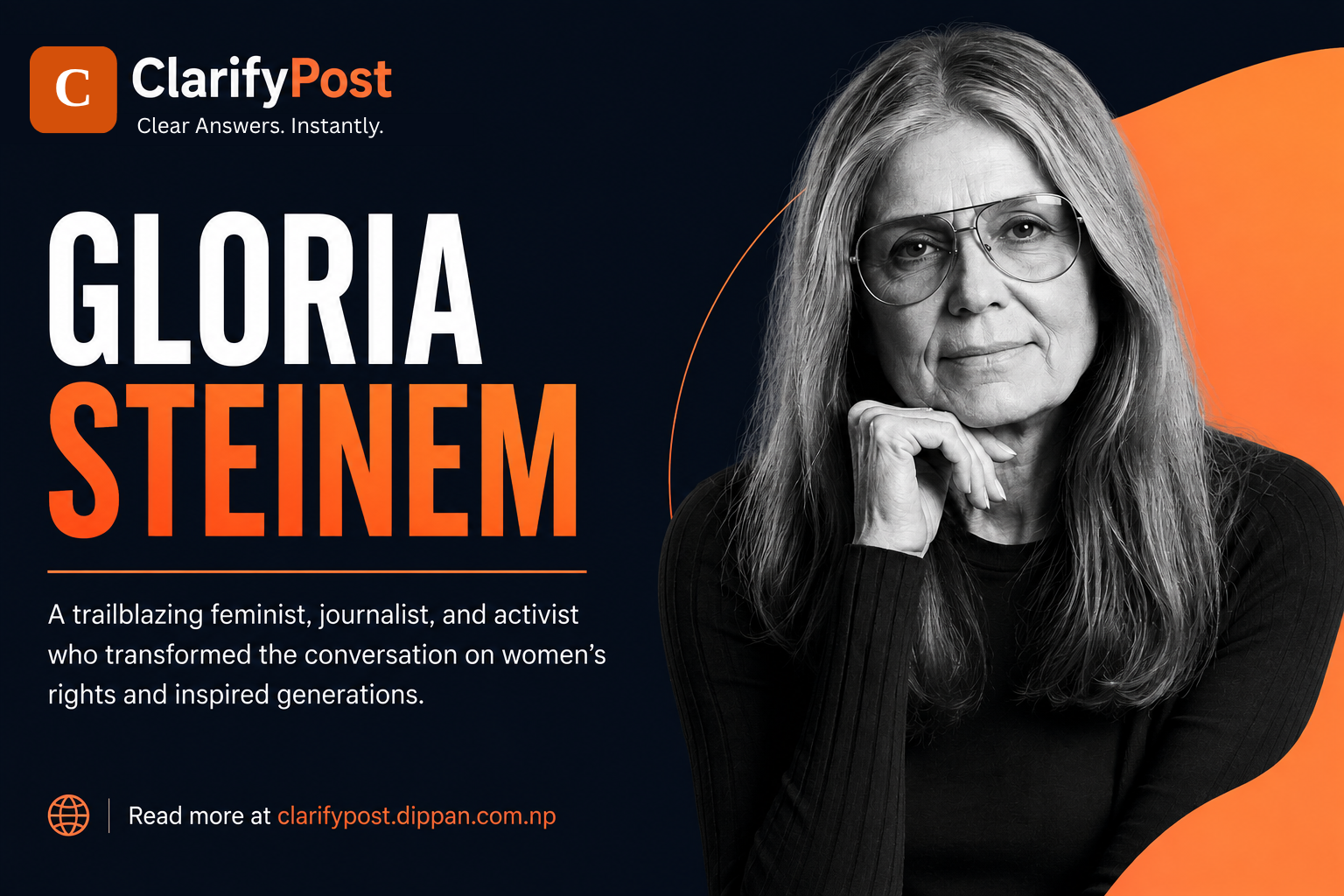
Gloria Steinem was an American journalist, writer, political organizer, and feminist activist who became one of the most recognizable leaders of the U.S. women's movement. Through journalism, public speaking, political organizing, and institutions such as Ms. magazine and the National Women's Political Caucus, she helped make women's equality, reproductive rights, workplace discrimination, media representation, and gender-based violence central issues in American public life.
Steinem died peacefully at her home in New York City on September 2, 2026, at the age of 92. Her foundation announced her death without giving a cause. Her death marked the end of more than six decades of highly visible activism, but her organizations, writing, ideas, and influence continue to shape discussions about equality and women's rights.
Key Takeaways
- Gloria Steinem combined journalism, organizing and political advocacy to expand the modern U.S. women's movement.
- Her work helped place reproductive rights, workplace equality and gender-based violence at the center of public debate.
- Her legacy includes major institutional achievements as well as controversies that remain part of her historical record.
Gloria Steinem became famous at a time when women in the United States were challenging legal, economic, cultural, and political structures that had restricted their choices for generations. Her importance was not limited to one law or one organization. She helped create a broader infrastructure for the modern women's movement: magazines, political networks, advocacy organizations, grassroots campaigns, public demonstrations, and media strategies.
Her career also contained contradictions and controversies, including criticism of her political positions and questions surrounding work she performed for a CIA-funded organization in the late 1950s and early 1960s.
Understanding Steinem therefore requires looking at both what she achieved and how she achieved it.
Early Life: Growing Up in Ohio
Gloria Marie Steinem was born on March 25, 1934, in Toledo, Ohio, to Ruth and Leo Steinem.
Her childhood was not conventional. Her father worked as a traveling salesman, and her parents divorced when she was young. After the divorce, Gloria spent part of her youth helping care for her mother before eventually leaving Ohio to pursue higher education.
She attended Smith College in Massachusetts, where she studied government and graduated magna cum laude in 1956.
After college, Steinem received a Chester Bowles Fellowship and spent two years studying and researching in India. The experience exposed her to grassroots political organizing and influenced her later understanding of social movements and nonviolent activism.
Her time in India became especially important because she later drew inspiration from Mahatma Gandhi's organizing methods.
From Young Journalist to National Figure
Steinem initially built her career as a journalist rather than as a professional political activist.
She wrote about culture, politics, contraception, women's lives, and social issues at a time when female journalists were often expected to focus on lifestyle or entertainment rather than serious political subjects.
In 1963, Steinem took one of the most famous journalistic assignments of her early career.
She worked undercover as a Playboy Bunny at the New York Playboy Club and documented the working conditions and treatment of the women employed there.
The resulting article, "A Bunny's Tale," exposed exploitative employment practices and became an important early example of the investigative journalism that would later define parts of her public career.
The assignment also demonstrated something that would become central to Steinem's activism:
personal experience could be turned into public evidence and then into political pressure.
In 1968, she joined the newly created New York magazine, where she became a political writer and columnist.
The following year, an article titled "After Black Power, Women's Liberation" helped establish her as a nationally recognized feminist voice.
The Moment That Changed Her Activism
One of the most important turning points in Steinem's life came in 1969.
She covered an abortion speak-out in Greenwich Village, New York. Steinem had undergone an abortion herself in London at age 22, and speaking publicly about the experience transformed her relationship with the women's movement.
She later described the event as the point at which she became an active feminist.
From then on, reproductive freedom became one of the central issues of her political activism.
Her approach was not limited to writing about feminism. She increasingly moved between journalism, public speaking, grassroots organizing, political campaigns, demonstrations, fundraising, and institution building.
The Birth of Ms. Magazine
In the early 1970s, Steinem recognized that the women's movement needed its own media platform.
Together with Patricia Carbine and Letty Cottin Pogrebin, she helped create Ms. magazine.
The magazine first appeared as an insert in New York magazine in 1971 and became an independent publication in 1972.

Ms. became more than a conventional magazine. It provided a national platform for discussions about:
- workplace discrimination
- reproductive rights
- domestic violence
- sexual harassment
- political representation
- race and gender
- economic inequality
- women's health
- cultural stereotypes
Steinem remained associated with the magazine for decades and became one of its most recognizable public figures.
This was one of her greatest strategic achievements: she helped create a media institution capable of turning previously marginalized experiences into mainstream political issues.
What Did Gloria Steinem Do as an Activist?
Steinem's activism covered much more than women's voting rights.
Her work included reproductive freedom, equal rights, political representation, workplace equality, racial justice, media representation, violence against women, LGBTQ+ rights, and international women's rights.
Equal Rights Amendment
Steinem became a major public campaigner for the Equal Rights Amendment (ERA).
In 1970, she testified before the Senate Judiciary Committee in support of the amendment.
The ERA became one of the major legislative goals of the U.S. women's movement, and Steinem spent decades promoting it through speeches, organizing, political campaigning, and media advocacy.
National Women's Political Caucus
In 1971, Steinem was among the women who helped establish the National Women's Political Caucus.
The organization was designed to increase women's participation in political life and to help women seek elected and appointed office.
Its strategy addressed an important problem: political equality required not only changing laws but also increasing the number of women able to participate directly in government.
Women's Action Alliance
Steinem also co-founded the Women's Action Alliance in 1971.
The organization supported feminist activists and worked on issues including nonsexist and multiracial children's education and feminist legislation.
Ms. Foundation for Women
Steinem became a founding president of the Ms. Foundation for Women, which supported grassroots projects focused on empowering women and girls.
This reflected another major feature of her activism: building institutions capable of funding and supporting other activists instead of making the movement dependent on a single public figure.
Women's Media Center
In 2005, Steinem, Jane Fonda and Robin Morgan co-founded the Women's Media Center.
The organization works to increase women's visibility and influence in media.
That mission closely matched Steinem's belief that representation matters because the media affects which people are seen as leaders, experts, victims, professionals, and decision-makers.
Take Our Daughters to Work Day
Steinem also helped establish Take Our Daughters to Work Day, an initiative intended to expose girls to professional opportunities and broaden their expectations about what careers they could pursue.
Her Work on Reproductive Rights
Reproductive freedom became one of Steinem's most consistent political causes.
She supported abortion rights and worked with organizations focused on protecting access to reproductive healthcare.
In 1977, she co-founded Voters for Choice, a political organization focused on electing candidates supportive of reproductive rights.
She later became involved with younger-generation reproductive-rights organizing, including the organization that became URGE.
Her abortion-rights activism was also personal. Her decision to publicly discuss her own abortion helped challenge the stigma surrounding women discussing reproductive healthcare openly.
Fighting Violence Against Women
Steinem's activism increasingly connected gender inequality to violence.
She wrote and spoke about:
- sexual violence
- domestic violence
- child abuse
- sex trafficking
- female genital mutilation
- sexual harassment
- exploitation of women
In 1979, she wrote about female genital mutilation in Ms. magazine, helping bring the issue to wider public attention in the United States.
She also co-produced an Emmy Award-winning HBO documentary examining child abuse and dissociative identities.
International Activism
Steinem's activism eventually expanded beyond the United States.
She worked with international women's organizations and participated in global campaigns related to equality, peace, violence against women, and political representation.
One of the most visible examples came in 2015, when Steinem joined an international group of women peace activists that crossed the Korean Demilitarized Zone from North Korea into South Korea.
The initiative called for peace, family reunification, and greater participation by women in peace-building efforts.
Her international work reflected a broader belief that women's rights could not be separated from questions of war, peace, poverty, race, and political power.
Gloria Steinem and American Politics
Steinem was never simply a commentator standing outside politics.
She became deeply involved in electoral politics and Democratic Party campaigns.
Her political engagement can be traced back to the 1950s, but it became much more significant during the political movements of the 1960s.
1968
In 1968, Steinem supported George McGovern and worked across several campaign functions, including writing, fundraising, lobbying delegates, and press work.
She was also a strong critic of the Vietnam War and supported civil-rights causes.
1972
Steinem supported women's participation inside the Democratic Party and ran as a delegate for Shirley Chisholm in New York in 1972, although she was unsuccessful.
The 1972 election also demonstrated one of the tensions within the women's movement: activists wanted reproductive rights and women's equality incorporated more strongly into party platforms.
2004
By 2004, Steinem was a strong critic of the George W. Bush administration, particularly over reproductive rights and other issues she associated with women's equality and social policy.
2008
During the 2008 Democratic presidential campaign, she discussed both Hillary Clinton and Barack Obama in the context of civil rights, feminism, environmentalism, and opposition to the Iraq War.
2016
Steinem endorsed Hillary Clinton for president.
She also drew criticism after comments about young women supporting Bernie Sanders, and later apologized for remarks that had been widely criticized.
In 2017, she served as an honorary co-chair and speaker at the Women's March on Washington following Donald Trump's inauguration.

Was Gloria Steinem a Politician?
Not in the conventional sense.
Steinem was not a member of Congress, governor, or cabinet official. Her political influence came primarily from activism, journalism, public speaking, organizing, fundraising, coalition-building, and endorsements.
She helped influence politics by changing which issues politicians had to address and by creating networks that encouraged women to run for office.
This distinction is important.
Steinem's political career was primarily the career of an activist-organizer rather than an elected politician.
Her Political Views
Steinem described herself as a radical feminist, although she was often categorized more broadly as a liberal feminist.
Her activism included strong positions on:
- reproductive freedom
- equal rights
- women's political representation
- racial and gender equality
- sexual violence
- workplace discrimination
- media representation
- same-sex marriage
- transgender rights
- opposition to some forms of militarism
Her views also changed over time.
For example, her early statements concerning transgender people were later clarified, and by 2013 she explicitly expressed support for transgender people's right to live authentically.
This evolution illustrates an important feature of her long career: Steinem continued to revise and explain her positions as political and social debates changed.
The CIA Controversy
One of the most controversial parts of Steinem's biography concerns her work in the late 1950s and early 1960s.
From 1958 to 1962, she worked with the Independent Research Service, an organization that was substantially financed by the CIA.
The connection became public later and generated criticism from radical feminists and political opponents.
Steinem acknowledged the relationship but denied having continuing ties to the CIA after her work there.
The episode remains part of her biography because it shows that her political history was more complicated than the image of Steinem as a lifelong, uninterrupted feminist organizer.
Steinem's public influence was enormous, but she was not universally accepted. She faced criticism from conservatives, anti-abortion activists, and members of the feminist movement itself. Her CIA-linked work, political alliances, and some of her positions generated significant debate throughout her career.
Personal Life
For much of her adult life, Steinem did not marry.
In 2000, at age 66, she married David Bale, an entrepreneur and activist and the father of actor Christian Bale.
The marriage lasted only three years. David Bale died in 2003.
Steinem had no biological children.
Her personal life was frequently discussed because she challenged conventional expectations surrounding marriage, family, career, and women's independence.
She lived in New York City for decades, and her historic home became a gathering place for activists, writers, and feminist thinkers.
Her Books and Writing
Steinem was also a prolific author.
Among her best-known books and collections are:
- Outrageous Acts and Everyday Rebellions
- Revolution from Within
- Moving Beyond Words
- My Life on the Road
- The Truth Will Set You Free, But First It Will Piss You Off!
- My Life on the Road
Her writing repeatedly connected individual experiences with larger political structures.
That approach became one of her signatures: rather than treating discrimination as isolated personal problems, she argued that individual experiences often reflected broader systems of power.
For readers interested in how information and human knowledge are preserved and challenged in the digital era, see ClarifyPost's guide to how Wikipedia works and why people rely on it.
Steinem, Media, and the Information Age
One of Steinem's most enduring contributions was her understanding that media itself is a form of political power.
That idea is particularly relevant today.
Modern social media allows anyone to publish, but it also creates new problems involving misinformation, manipulated images, fake stories, and algorithmic amplification.
ClarifyPost's guide on how to spot AI-generated images on social media explores one of the modern problems that journalists and readers now face: distinguishing authentic information from synthetic media.
The technology has changed dramatically since Steinem began writing, but the underlying question remains similar:
Who controls information, whose voices are represented, and how can the public determine what deserves trust?
Major Achievements
| Achievement | Why it mattered |
|---|---|
| Co-founded Ms. magazine | Created a major independent platform for feminist journalism |
| Co-founded the National Women's Political Caucus | Helped expand women's participation in electoral politics |
| Campaigned for the Equal Rights Amendment | Made constitutional gender equality a major national issue |
| Founded/co-founded women's organizations | Built long-term institutions supporting women and girls |
| Advocated reproductive freedom | Helped make abortion rights a central political issue |
| Supported international women's rights | Expanded her activism beyond U.S. politics |
| Co-founded Women's Media Center | Challenged gender inequality in media |
| Helped establish Take Our Daughters to Work Day | Encouraged girls to imagine broader professional futures |
| Investigative journalism | Used journalism to expose gender-based exploitation |
| Public speaking and organizing | Connected national politics with grassroots activism |
Awards and Honors
Steinem received major recognition during her lifetime.
Among the most significant were:
- Presidential Medal of Freedom in 2013
- National Women's Hall of Fame induction in 1993
- Society of Professional Journalists Lifetime Achievement in Journalism Award
- National Magazine Awards
- Women's Media Center and Ms. Foundation honors
- Princess of Asturias Award for Communication and Humanities in 2021
- inclusion on the BBC 100 Women list in 2023
The Presidential Medal of Freedom was especially significant because it is the United States' highest civilian honor.

How Did Gloria Steinem Change the Women's Movement?
Steinem's greatest contribution was not a single speech or publication.
She helped change the infrastructure of activism.
She showed that journalism could support organizing. She showed that magazines could become political institutions. She helped create organizations that could train political candidates, support grassroots activists, fund women's projects, influence media representation, and organize voters.
Her influence can therefore be understood in four connected areas:
Journalism → Public awareness → Political organizing → Institutional change. Steinem repeatedly moved between all four, using each one to strengthen the others.
Gloria Steinem's Final Years
Steinem remained publicly engaged for much of her later life.
She continued to write, speak, mentor activists, participate in political discussions, and support women's organizations.
Her home in New York remained a place where activists and thinkers gathered.
Her public influence also continued through films, documentaries, interviews, books, and younger generations of feminist organizers.
Her life was later dramatized in the 2020 film The Glorias, directed by Julie Taymor.
She was also featured in the HBO documentary Dear Ms., released in 2025.
What Happened to Gloria Steinem in 2026?
Gloria Steinem died on September 2, 2026, at her home in New York City. She was 92.
Her foundation said she died peacefully surrounded by people who loved her. The foundation did not announce a cause of death.
She had remained associated with equality activism until the end of her life.
Her death prompted tributes from politicians, activists, journalists, writers, and organizations that had worked with or been influenced by her.
Her final legacy is therefore not simply the list of organizations she founded.
It is the continuation of a movement she helped make visible.
What Is Gloria Steinem's Legacy?
Gloria Steinem's legacy is difficult to reduce to one sentence.
To supporters, she was one of the defining architects of modern American feminism: a journalist who became an organizer, a public intellectual who became an institution builder, and a political activist who helped push women's rights into mainstream politics.
Critics have challenged parts of her record, including her political alliances, some of her earlier statements, and her relationship with a CIA-funded organization.
Both sides are important when examining her historical role.
What remains difficult to dispute is the scale of her influence.
She helped make it normal for women to publicly discuss issues that had once been treated as private: abortion, sexual harassment, domestic violence, workplace discrimination, unequal political representation, and the social expectations attached to gender.
She also helped create organizations that continued working long after individual campaigns ended.
That may ultimately be her greatest achievement.
Gloria Steinem did not simply argue for social change. She helped build the organizations, media platforms, political networks, and public language through which later generations could continue pursuing it.
Frequently Asked Questions
Q: Who was Gloria Steinem?
A: Gloria Steinem was an American journalist, writer, political organizer, and feminist activist who became one of the most prominent leaders of second-wave feminism in the United States.
Q: When did Gloria Steinem die?
A: Gloria Steinem died on September 2, 2026, at the age of 92, at her home in New York City.
Q: What was Gloria Steinem famous for?
A: She was best known for her feminist activism, investigative journalism, co-founding Ms. magazine, advocating reproductive rights and the Equal Rights Amendment, and helping build organizations that increased women's political and social influence.
Q: What did Gloria Steinem do for feminism?
A: She used journalism, organizing, public speaking, political campaigns, fundraising, and institution-building to advance women's equality and bring issues such as reproductive rights, sexual harassment, workplace discrimination, and violence against women into public debate.
Q: Did Gloria Steinem create Ms. magazine?
A: She was one of the principal co-founders of Ms. magazine, working with Patricia Carbine and Letty Cottin Pogrebin. The publication first appeared as an insert in 1971 and became an independent magazine in 1972.
Q: Was Gloria Steinem a politician?
A: She was not an elected politician. Her political influence came primarily through journalism, activism, organizing, campaigning, fundraising, public speaking, and supporting political candidates and causes.
Q: Did Gloria Steinem support Hillary Clinton?
A: Yes. Steinem endorsed Hillary Clinton during the 2016 U.S. presidential election campaign and participated in political events supporting her.
Q: What organizations did Gloria Steinem help establish?
A: Her organizational work included the National Women's Political Caucus, Women's Action Alliance, Ms. Foundation for Women, Voters for Choice, Women's Media Center, and other women's-rights initiatives.
Q: Did Gloria Steinem receive the Presidential Medal of Freedom?
A: Yes. President Barack Obama awarded Steinem the Presidential Medal of Freedom in 2013, the highest civilian honor in the United States.
Q: Did Gloria Steinem have children?
A: She had no biological children. She married David Bale in 2000 and became stepmother to his children. Bale died in 2003.
Q: What was the controversy involving Gloria Steinem and the CIA?
A: Steinem worked from 1958 to 1962 with the Independent Research Service, an organization largely financed by the CIA. The relationship later became controversial. Steinem acknowledged the work and denied continuing CIA ties.
Q: What is Gloria Steinem's most important achievement?
A: There is no single universally accepted answer, but her most lasting achievements include helping establish Ms. magazine, building women's political networks, advocating reproductive freedom and equal rights, and creating institutions that continued feminist organizing across generations.
Sources and Further Reading
Official Gloria Steinem Biography
National Women's History Museum — Gloria Steinem