Dr. Sahar Yousef: The Cognitive Neuroscientist Turning Brain Science Into Better Work
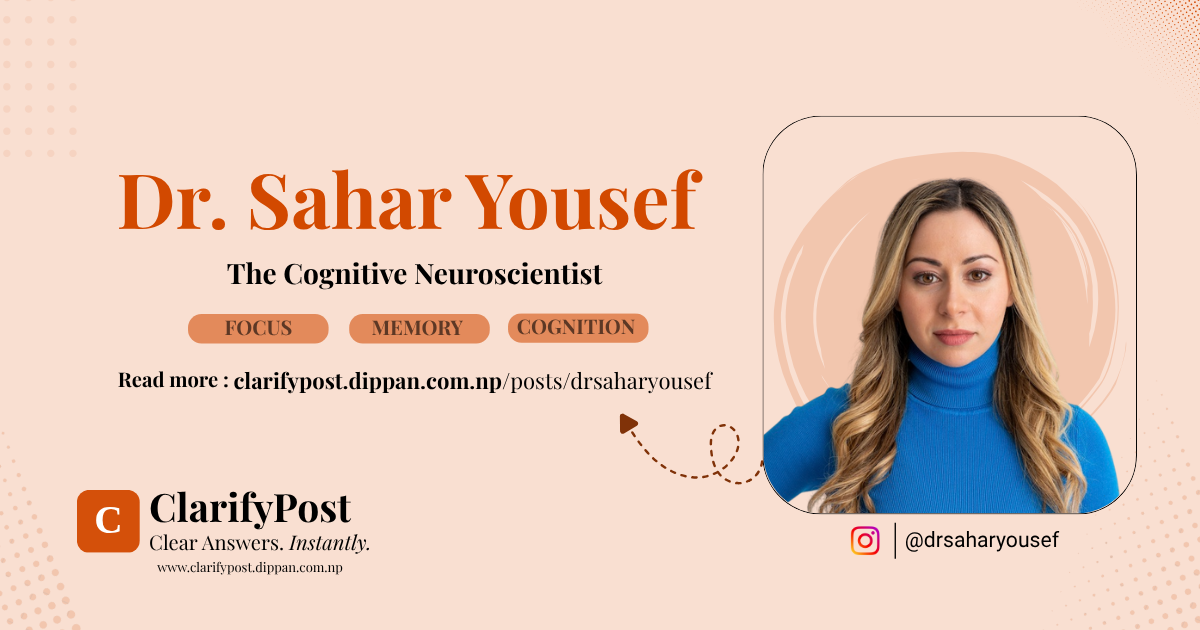
Dr. Sahar Yousef is a cognitive neuroscientist, UC Berkeley lecturer, researcher, and productivity educator whose work connects attention, memory, neuroplasticity, digital habits, and human performance. Her central question is practical: how can people design work and technology habits around the brain they actually have?
That question is increasingly important in a world of smartphones, notifications, short-form content, constant multitasking, and work that rarely seems to end. On September 8, 2026, Yousef discussed those themes with Raj Shamani on Figuring Out in an episode titled Neuroscientist's Guide To 10X Your Focus & Memory.
What This Article Covers
- Academic background: Yousef's UC Berkeley training in cognitive science and vision science.
- Core subjects: attention regulation, memory, cognitive control, productivity, and digital wellness.
- Podcast discussion: multitasking, phone habits, motivation, breaks, burnout, chronotypes, and cognitive training.
- Important context: "10X Your Focus & Memory" is the episode title, not proof of a literal tenfold cognitive increase.
- Primary sources: official UC Berkeley records, Yousef's website, and the podcast episode listing.
Who Is Dr. Sahar Yousef?
Dr. Sahar Yousef is a cognitive neuroscientist and lecturer associated with UC Berkeley's Haas School of Business. According to her official Berkeley profile, she completed her undergraduate education and PhD at Berkeley. Her 2018 doctorate was in Vision Science, with research focused on cognitive and attention regulation training.
Her work is notable because it moves between academic research and practical education. Rather than treating productivity as a simple matter of willpower or time management, Yousef examines how attention, energy, technology, and the environment shape the quality of human work.
What Does a Cognitive Neuroscientist Study?
Cognitive neuroscience studies the relationship between mental processes and the brain. Its subjects can include attention, memory, perception, learning, decision-making, reasoning, and cognitive control. Researchers may use behavioral experiments, neuroimaging, EEG, and related methods to study how cognition works.
Yousef's doctoral research focused on Cognitive and Attention Regulation Training. Berkeley's alumni records identify Michael Silver as her doctoral adviser. That background helps explain why her public work treats focus as a cognitive process that can be supported by training and environment, rather than only as a motivational problem.
From Brain Science to Better Work
Yousef's work sits at the intersection of neuroscience and modern knowledge work. Her research and teaching address questions such as:
- How does attention become fragmented by constant context switching?
- What role does memory play in learning and performance?
- How do notifications and digital stimulation compete for attention?
- Why can a long workday still produce little meaningful progress?
- How should people use breaks and recovery to protect energy?
- How can technology be used intentionally instead of automatically?
This approach is relevant to students, developers, entrepreneurs, creators, executives, and anyone whose work depends on sustained attention.
Why Multitasking Can Feel Productive
One of the most familiar themes in Yousef's work is the difference between being busy and making progress. People often describe checking messages while writing, switching between browser tabs, and answering email during a meeting as multitasking. In practice, many of these behaviors are rapid shifts between tasks.
Every shift creates a cost: the mind has to reconstruct what it was doing, remember the next step, and suppress competing information. For demanding work, protecting a period of uninterrupted attention can be more valuable than extending the number of hours spent at a desk.
The practical principle is straightforward:
Doing more things at once does not necessarily mean getting more done. Reduce avoidable interruptions, define one clear next action, and make the desired behavior easier than the distracting alternative.
Why a Phone Can Affect Attention Even When It Is Not Being Used
The Raj Shamani conversation discusses digital hygiene and the way smartphones can compete for attention even when a person is not actively scrolling. A visible phone, a vibration, or the expectation of an incoming message can create a background demand on attention.
This does not mean technology is inherently harmful. Phones provide communication, navigation, education, work tools, and access to useful information. The more useful question is whether the device is helping a person choose where attention goes or repeatedly making that choice for them.
Simple environmental changes can help: silence non-essential alerts, move distracting apps away from the home screen, use scheduled check-in windows, and put the phone physically out of reach during demanding work.
The Connection Between Attention and Memory
Memory is not separate from attention. If information is never fully attended to, it is less likely to be encoded clearly enough to retrieve later. This is why more hours of studying do not automatically produce better learning when those hours are repeatedly interrupted.
Yousef's research background connects cognitive training with attention, memory, information processing, and overall performance. The practical lesson is not that memory can be upgraded by a single trick. It is that learning improves when people protect attention, work with manageable information, and return to material deliberately.
Breaks, Recovery, and the 3M Framework
The podcast episode introduces Yousef's 3M framework for breaks: Micro, Meso, and Macro breaks. The categories describe recovery at different time scales rather than treating every break as the same.
- Micro breaks: brief pauses during a work period to reset attention or change physical state.
- Meso breaks: longer recovery periods between demanding blocks of work, meetings, or study.
- Macro breaks: substantial time away from work that supports broader recovery and prevents work from becoming continuous.
The larger idea is that sustainable performance depends on energy management as well as time management. A person can spend more hours working while producing less useful output if fatigue has already degraded attention and judgment.
The Becoming Superhuman Lab and Public Education
Yousef runs the Becoming Superhuman Lab, which translates research and teaching into education about productivity, digital dependence, burnout prevention, focus, and energy management. UC Berkeley says she has delivered hundreds of talks and keynotes to knowledge workers and executives in more than 50 countries.
Berkeley and Yousef's biography also note that she was selected by Thinkers50 as one of the top 30 management thinkers to watch in 2024. Her work has been featured by outlets including Forbes, The Wall Street Journal, Bloomberg, CNBC, and The New York Times, according to UC Berkeley Executive Education.
Dr. Sahar Yousef on Raj Shamani's Figuring Out
The episode is listed as FO559, titled Neuroscientist's Guide To 10X Your Focus & Memory, and released on September 8, 2026. Apple Podcasts lists a runtime of approximately two hours and 55 minutes.
Topics discussed include:
- The biology of focus and motivation
- Habits, addiction, and digital dependence
- Multitasking and task switching
- Short-form versus long-form content
- Smartphones, social media, and digital hygiene
- Mind-wandering and attention
- Breaks, recovery, and burnout
- Body clocks and chronotypes
- Cognitive training and human performance
The title should be read as podcast framing, not as a blanket scientific claim. There is no basis in the supplied sources for interpreting "10X" as a guaranteed literal multiplication of cognition for every listener.
Watch Dr. Sahar Yousef on Raj Shamani's Figuring Out
Full conversation: Dr. Sahar Yousef on Raj Shamani's Figuring Out. The thumbnail opens an embedded YouTube player.
Dr. Sahar Yousef's Core Ideas
| Area | The bigger idea |
|---|---|
| Focus | Attention is limited and benefits from deliberate protection. |
| Memory | Clearer attention supports better learning and remembering. |
| Multitasking | Frequent task switching can reduce efficiency on demanding work. |
| Technology | Digital tools are useful, but unmanaged stimulation can compete for attention. |
| Breaks | Recovery is part of sustainable performance, not the opposite of productivity. |
| Burnout | Energy and workload both matter. |
| Productivity | More hours do not automatically equal better work. |
| Cognitive training | Attention and performance can be studied and practiced, but claims should remain evidence-based. |
Frequently Asked Questions
Who is Dr. Sahar Yousef?
Dr. Sahar Yousef is a cognitive neuroscientist and UC Berkeley lecturer whose work focuses on cognitive training, attention, memory, productivity, digital wellness, and human performance.
What did Sahar Yousef study at UC Berkeley?
She studied Cognitive Science as an undergraduate and completed a PhD in Vision Science at UC Berkeley. Her doctoral research focused on cognitive and attention regulation training.
What is Dr. Sahar Yousef known for?
She is known for translating cognitive neuroscience into practical approaches to focus, productivity, cognitive performance, digital wellness, and burnout prevention.
What was her Raj Shamani podcast episode about?
The September 8, 2026 episode of Figuring Out explored focus, memory, motivation, habits, multitasking, digital hygiene, breaks, burnout, social media, chronotypes, and cognitive training.
Does "10X Your Focus & Memory" mean her methods literally increase cognition tenfold?
No such blanket conclusion should be drawn from the title. "10X Your Focus & Memory" is the podcast episode title, not a general scientific guarantee that the methods produce a literal tenfold increase in cognitive ability.
Sources and Image Credits
- UC Berkeley Executive Education: Dr. Sahar Yousef profile
- UC Berkeley Cognitive Science: Sahar Yousef
- UC Berkeley Vision: Alumni Directory
- Dr. Sahar Yousef: Official website
- Dr. Sahar Yousef: About page
- Raj Shamani: Figuring Out, FO559
- Apple Podcasts: episode details and timestamps
- Headshot: UC Berkeley Executive Education faculty profile
More ClarifyPost Guides
Continue exploring related topics on ClarifyPost:
- How Do AI Agents Work? Tools, Memory, Planning, Actions & Real Examples
- Agentic SEO: How to Market to AI Assistants in 2026
- What Is a Data Detox and How to Do It This Weekend
- The Dead Internet Theory: How to Filter AI Slop from Your Feeds
This article distinguishes claims documented by official profiles from themes discussed in a podcast. It is an informational overview, not medical advice or a guarantee of cognitive improvement.