Nepal Flood 2026: How the Disaster Happened, Who Helped, and What Comes Next
The 2026 Nepal flood disaster began on August 26, 2026, when a catastrophic surge entered the Bhote Koshi River system near the Nepal–China border. The event caused flash flooding, landslides and massive debris flows across downstream communities, destroying homes, roads, bridges and hydropower infrastructure.
Key Takeaways
- The disaster began with a rapid high-altitude ice-and-rock event that sent water and debris into the Bhote Koshi system.
- Flooding and landslides damaged communities, transport links and hydropower infrastructure across several downstream districts.
- Casualty and impact figures remain provisional while rescue, recovery and verification work continues.
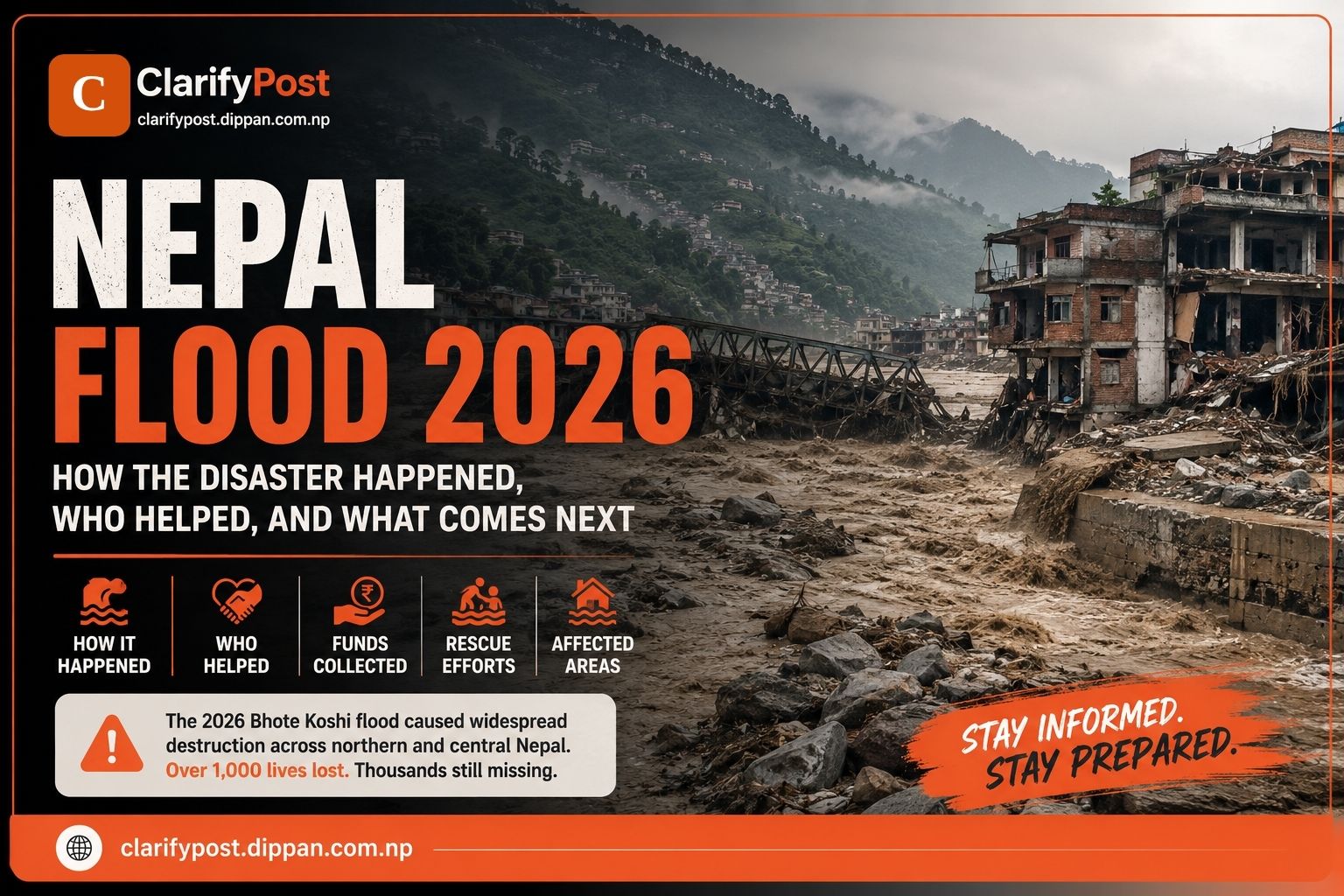
The disaster was not a typical monsoon flood. Preliminary scientific assessments indicate that an ice-and-rock avalanche associated with a glacier collapse in the Himalayan border region rapidly displaced water and debris into the river system.
The result was a powerful debris-filled flood that travelled downstream through the Bhote Koshi, Trishuli and connected river corridors. The destruction spread far beyond Rasuwa, carrying mud, vehicles, buildings and debris into downstream districts.
How Did the Nepal Flood Happen?
The first major question is simple: what actually caused the flood?
The disaster began in the high Himalayas near the Nepal–China border. Scientists believe a large section of ice and rock collapsed from the mountainous terrain and entered the upstream river system. The impact temporarily obstructed the flow and then produced a sudden, extremely powerful release of water, ice, sediment and rock.
Satellite and seismic observations indicate that the collapse generated an enormous debris flow that entered the river system and sent the water level rising dramatically.
This matters because the event was fundamentally different from a flood caused only by prolonged rainfall. Instead of water gradually accumulating over hours or days, the river corridor was hit by a rapid pulse of water and debris.
The disaster combined a high-altitude geological and glacial event with a sudden downstream flood. That combination explains why the destruction was so severe and why communities had very little time to react.
Climate scientists have also warned that warming in the Hindu Kush Himalaya is increasing the instability of glaciers, ice and mountain slopes. A warmer climate does not mean that every individual flood is directly caused by climate change, but rising temperatures can increase the likelihood of glacier retreat, permafrost degradation and other conditions that make high-mountain hazards more dangerous.
Which Areas of Nepal Were Affected?
The first and hardest-hit areas were concentrated along the Bhote Koshi and Trishuli river corridors.
The major affected areas included:
- Rasuwa
- Nuwakot
- Dhading
- Gorkha
- Chitwan
- Tanahun
Bodies and flood debris were also recovered in Nawalparasi East and Nawalparasi West, demonstrating how far the material travelled downstream.
The damage was not limited to homes.
Roads and bridges were washed away, telecommunications infrastructure was damaged, communities were isolated, and multiple hydropower facilities were heavily affected.
How Big Was the Disaster?
Because rescue teams are still recovering bodies and searching inaccessible areas, the numbers have been changing.
| Impact | Reported figure |
|---|---|
| Bodies recovered | 1,000+ |
| People reported missing | 3,900+ |
| People rescued | 11,000+ |
| People impacted | ~1.6 million |
| Severely affected districts | 2 |
| Moderately affected districts | 3 |
| Security personnel mobilized | 21,000+ |
These figures should be treated as provisional because recovery and verification operations are continuing.
What Did the Nepal Government Do?
The government activated the country's security and disaster-management agencies.
The Nepali Army, Nepal Police and Armed Police Force were deployed for search, rescue, evacuation, transportation of relief materials and recovery operations.
Helicopters became essential because bridges and roads had been destroyed or blocked by mud and debris.
The government also established emergency coordination mechanisms to track missing people, coordinate with foreign embassies and manage rescue operations.
Relief operations included:
- emergency medical treatment
- food and drinking water
- temporary shelter
- transportation and evacuation
- fuel management
- restoration of telecommunications
- management and identification of human remains
- search operations around damaged hydropower tunnels
How Much Money Was Collected in the Prime Minister's Disaster Relief Fund?
The government appealed for donations to the Prime Minister's Natural Disaster Relief Fund.
By August 30, the fund had reportedly collected approximately Rs. 5.0246 billion, alongside foreign-currency contributions.
The government also released additional funds for immediate disaster response, search, rescue and relief operations.
The reported fund balance should not automatically be interpreted as money raised exclusively for this single flood. Government disaster funds can contain contributions and allocations associated with broader disaster-response activities.
What Did India Do to Help Nepal?
India was among the countries providing humanitarian assistance to Nepal.
India sent emergency relief materials including temporary shelters, blankets, hygiene supplies, medicines and food-related assistance.
India later expanded its contribution by providing specialized tunnel-rescue personnel and forensic experts to assist with the recovery and identification of victims.
Indian assistance therefore covered three major areas:
humanitarian supplies, specialized rescue capability and forensic identification.
What Did China Do?
China's role was particularly important because the disaster occurred near the Nepal–China border and the upstream region was directly connected to the Himalayan river system.
China provided financial assistance, emergency relief supplies and specialized technical support.
The Chinese government provided US$2 million in emergency assistance, while the Red Cross Society of China contributed another US$200,000.
China also deployed specialized rescue personnel to assist with difficult hydropower-tunnel rescue operations.
Chinese authorities additionally provided upstream information and monitoring support related to evolving flood risks.
What Did Other Countries Do?
Nepal received assistance and offers of support from several countries and international organizations.
| Country / Organization | Major assistance |
|---|---|
| India | Relief supplies, tunnel-rescue specialists and forensic experts |
| China | US$2 million government assistance, US$200,000 Red Cross support and technical teams |
| United Kingdom | Humanitarian assistance and rapid-response support |
| United States | Emergency humanitarian funding and disaster-response support |
| South Korea | Humanitarian funding and response personnel |
| Japan | Emergency tents, blankets and relief materials |
| Australia | Humanitarian funding and response personnel |
| UAE | Humanitarian and relief assistance |
| Pakistan | Emergency relief materials |
| UN agencies | Medical, shelter, water, sanitation and recovery support |
Why Was the Rescue So Difficult?
Nepal's geography was one of the biggest obstacles.
The worst-hit communities are surrounded by steep Himalayan terrain, narrow river valleys and fragile roads. Once bridges were destroyed and slopes became unstable, rescue teams could not simply drive into many locations.
Hydropower tunnels created another major challenge.
Mud, rocks and collapsed tunnel sections made it difficult to determine where workers were located. Rescue teams also faced difficult structural and environmental conditions.
This is why Nepal required specialized equipment and international expertise for some of the most complex rescue operations.
What Are the Major Consequences?
Loss of Life
More than 1,000 people had been reported dead by early September, with thousands more reported missing.
Destroyed Infrastructure
Roads, bridges, houses and telecommunications infrastructure were damaged or destroyed, leaving some communities isolated.
Hydropower Damage
Several hydropower projects were affected, threatening one of Nepal's most important sources of electricity and export revenue.
Displacement
Thousands of people lost homes, businesses and access to basic services.
Health Risks
Floodwater contamination, damaged sanitation systems and overcrowded temporary shelters created additional public-health risks.
Economic Damage
The total economic loss is still being assessed. The final cost will depend on damage to infrastructure, agriculture, tourism, homes, businesses and hydropower facilities.
What Happens Next?
The immediate priority remains finding missing people, recovering victims and delivering relief to survivors.
The second phase will be much larger: reconstruction and rehabilitation.
Nepal will need to rebuild roads, bridges, homes, communications networks and hydropower facilities while also improving its disaster-preparedness systems.
The disaster also raises important questions about Nepal's ability to monitor rapidly developing Himalayan hazards.
The country will need stronger:
- glacier and mountain monitoring
- early-warning systems
- river-level monitoring
- emergency communications
- specialized tunnel-rescue capabilities
- resilient bridges and roads
- hydropower risk assessments
- cross-border disaster coordination
The 2026 Bhote Koshi flood is therefore more than a story about a single river valley. It demonstrates how quickly a high-altitude mountain event can become a national humanitarian crisis when it intersects with settlements, infrastructure and critical energy projects.
The disaster highlights the need for stronger Himalayan monitoring, early-warning systems, resilient infrastructure and international cooperation among countries sharing the region's river systems.
Frequently Asked Questions
Q: When did the 2026 Nepal flood happen?
A: The major Bhote Koshi disaster struck on August 26, 2026, with severe impacts beginning around the Rasuwa area near the Nepal–China border.
Q: What caused the Nepal flood?
A: Preliminary evidence points to an ice-and-rock avalanche associated with a glacier collapse, which caused a sudden surge of water and debris into the Bhote Koshi river system.
Q: Which districts were affected?
A: Major affected districts included Rasuwa, Nuwakot, Dhading, Gorkha, Chitwan and Tanahun, with debris and recovered victims also reported farther downstream.
Q: How many people died?
A: More than 1,000 people had been reported dead by early September, although the exact figure remained subject to ongoing recovery and verification.
Q: How many people are missing?
A: Government disaster reporting placed the number of missing people in the thousands, including Nepali citizens, foreign nationals and workers connected to hydropower projects.
Q: How much money was collected in Nepal's disaster relief fund?
A: Approximately Rs. 5.0246 billion was reported in the Prime Minister's Natural Disaster Relief Fund by August 30, together with foreign-currency contributions.
Q: How did India help Nepal?
A: India provided humanitarian relief supplies, specialized tunnel-rescue personnel and forensic experts for victim identification.
Q: How did China help Nepal?
A: China provided US$2 million in government emergency assistance, US$200,000 through the Chinese Red Cross, relief materials and specialized technical rescue support.
Q: Did other countries help Nepal?
A: Yes. Countries including the United Kingdom, United States, South Korea, Japan, Australia, UAE and Pakistan, along with international organizations, provided funding, relief supplies or specialist assistance.
Q: Is the Nepal flood disaster over?
A: The immediate floodwaters have receded in many areas, but search, recovery, relief and reconstruction efforts are still ongoing. The long-term rebuilding process will take considerably longer.